%20(1)_edited.jpg)


Good Spot to be Queer: public spaces, love & LGBTQ+
- Gabriella Symss

- Oct 10, 2022
- 2 min read
Updated: Nov 20, 2022

In a country that only recently decriminalized homosexuality, where does a lesbian go on a Hinge date with another lesbian? Queer couples and, particularly Queer women/womxn, have varied experiences when it comes to navigating public space. Whether the purpose be sexual, romantic, professional, or just plain day-to-day, the question of how to negotiate these spaces can arise- consciously or not.
Queerness (used here to mean any gender or sexual orientation that does not conform to heteronormative standards) has not been relegated to the strictly private sphere in Indian histories. Its influence flows through the religious, the mythical, the political, and the social. But what is the shape of Queerness, sex, and romance in modern India?
One shape it has taken in urban circles has been the online sphere, and has now also spread its wings from the private to the (at least a bit more) public. However, for many that can usually take the form of specifically Queer events. Narita C explains how it has become easier to meet other Queer women at these events but that a feeling of safety seems to lessen outside those boundaries.
“There’s no public place where it feels comfortable to be Queer. I’ve never had any issues but I’m always cautious and feeling restricted”, she adds. “Even in some social situations you have to navigate a labyrinth of conversation before you can determine if this is a safe space.”
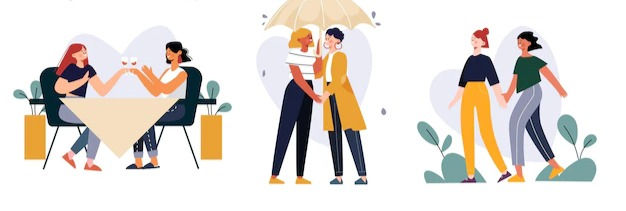
In Queering Public Space, a 2021 report by University of Westminster and built-environment firm Arup, one suggestion was the creation of ‘cosy corners’ that offer some degree of privacy away from stares, but are also not secluded.
Krish* a trans man who has lived in Bengaluru for the last six years, says that Queer events, LGBTQ+ club nights, and certain restaurants and pubs are some of the only spaces he goes on dates. “But I also want to sit around in public without worry. Whether I’m with someone or not. I don’t want it to be only in some designated areas.”
Gender-mainstreaming approaches used in public planning in Vienna also serves as another example of how public spaces can serve different segments of society. There is also a need to have these inclusive approaches apply to all spaces and not just to Queer-designated spaces.
“I would love to be able to hold my girlfriend’s hand anywhere. I know we aren’t very open with affection in public in India. But at least I want to hold her hand,” says trans woman Reena* who says she is a romantic who would like to live with her girlfriend one day soon.
It is key that common areas in our cities and towns not be geared only towards heteronormative usage- the large portion of which is straight and male. Queerness must have the area to roam. It is time to consider not just the changing of mind-sets, but the carving out of some actual room of one’s own.
*To indicate change of name.

Comments